Gerta Rozan's "Strip Picket"
Actress vows to "take it off" until role is reinstated!
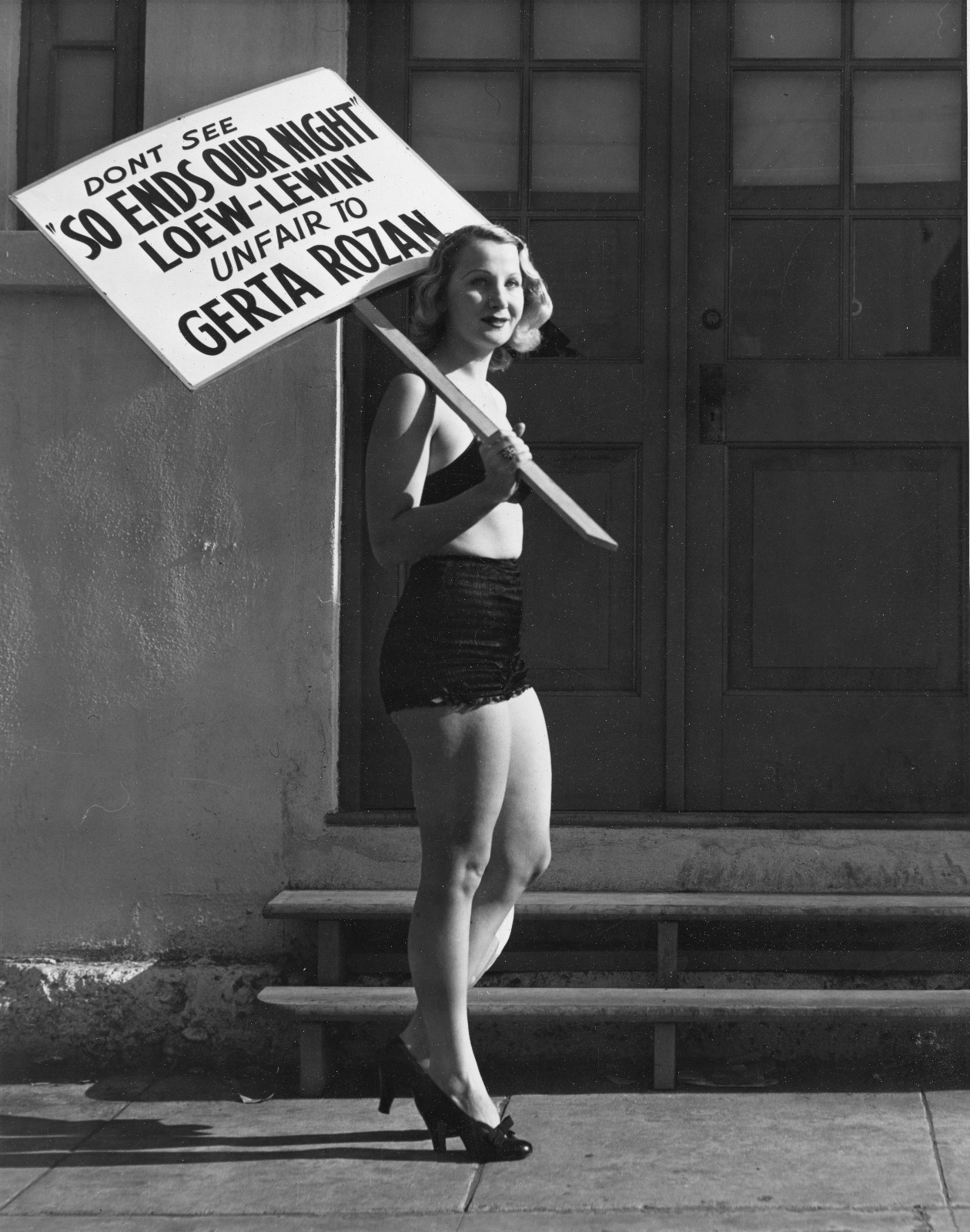
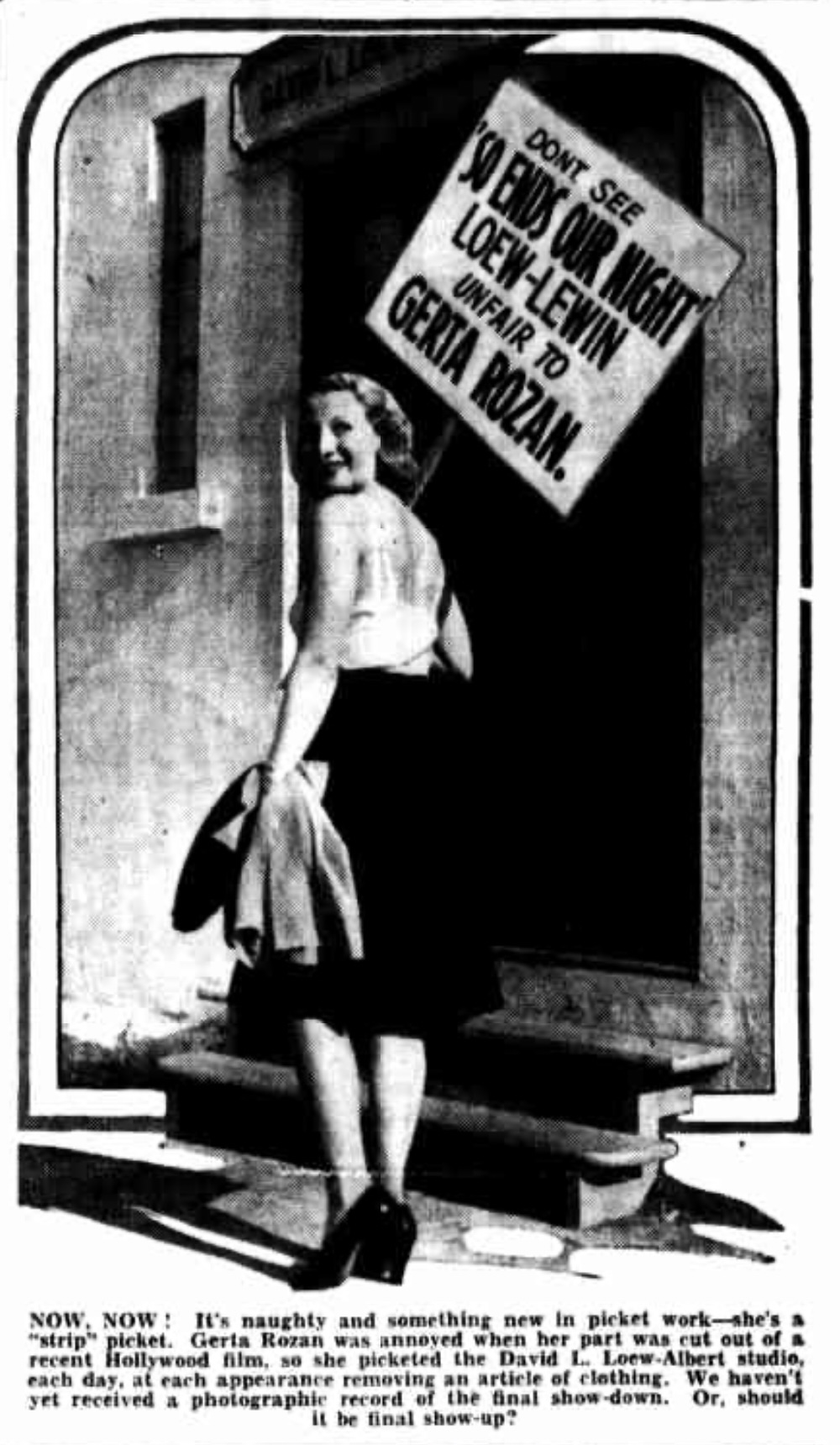
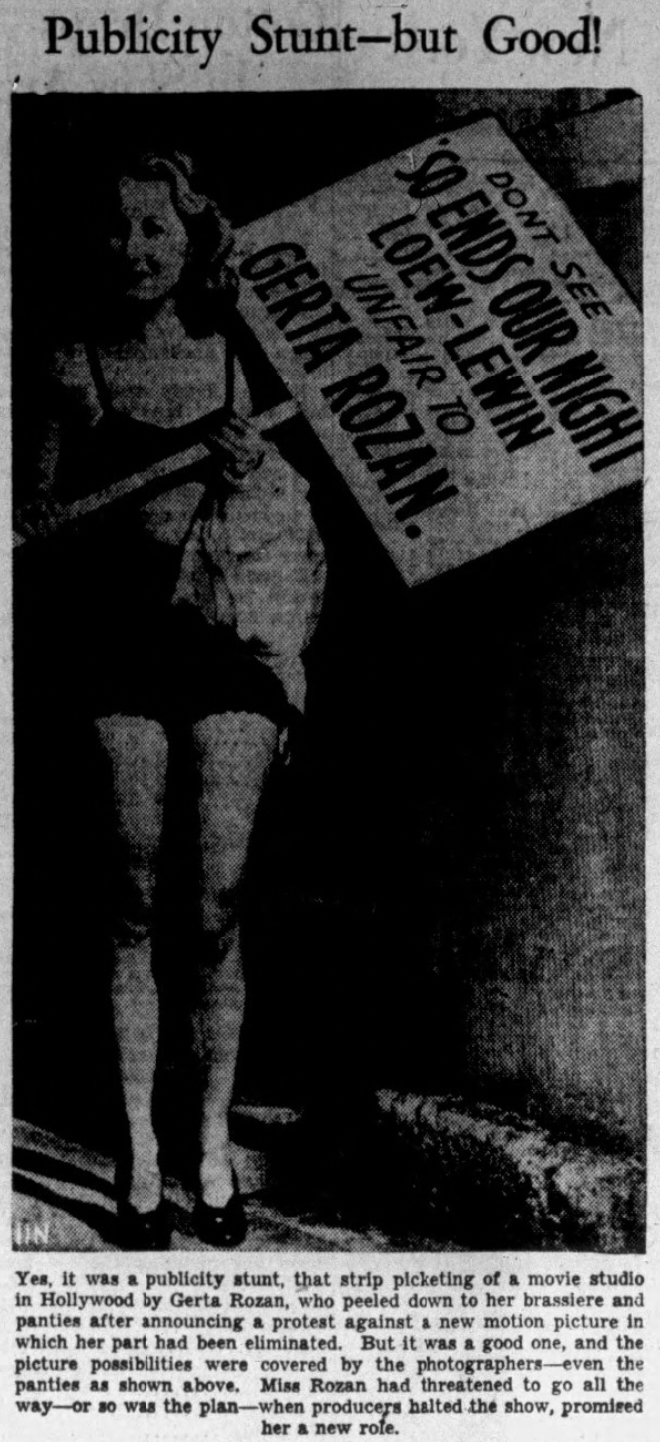
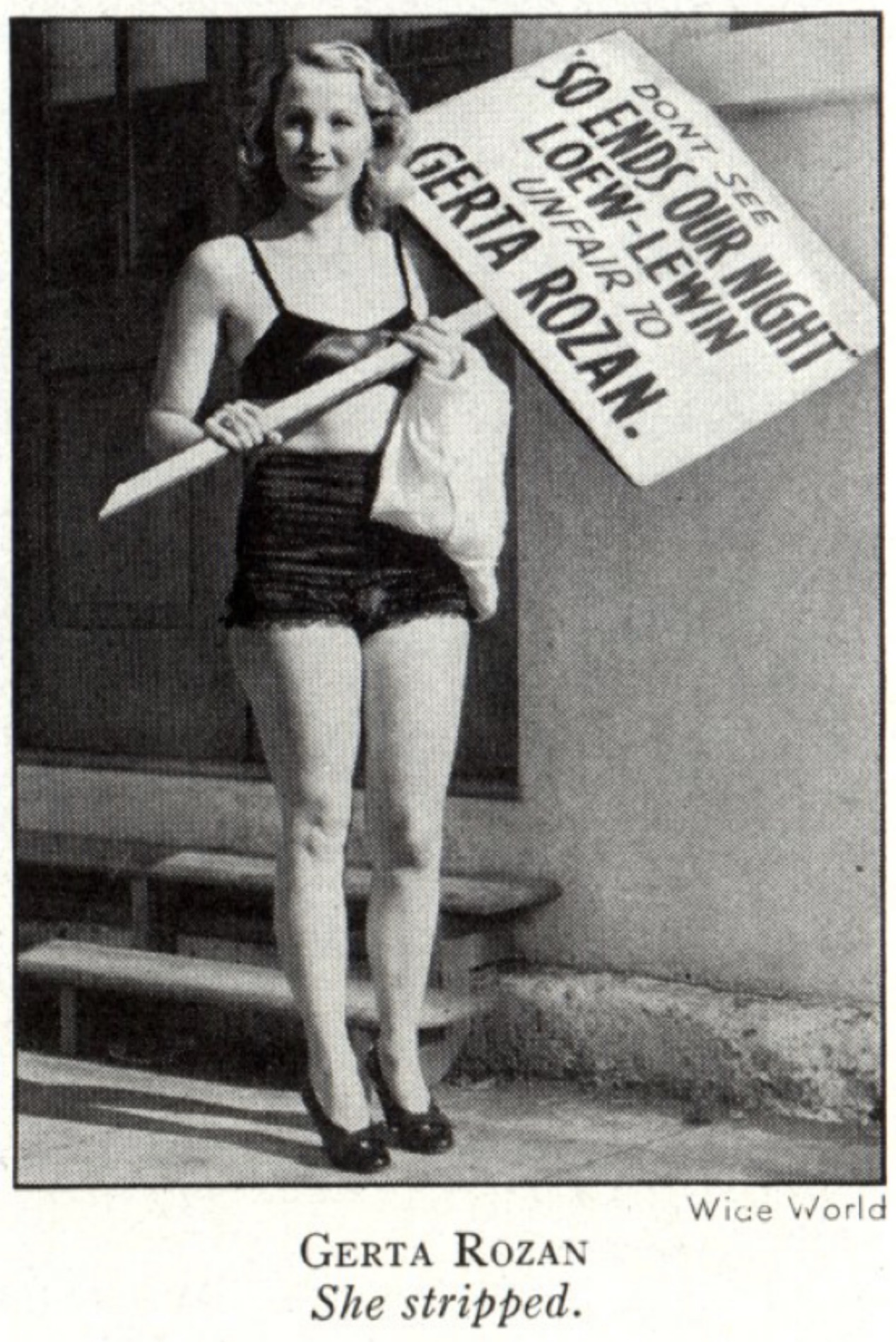
George Glass: I cooked up a stunt, just for the hell of it, that I called a "striptease picket." A girl in the picture [So Ends Our Night] named Gerta Rozan, an extremely well-stacked young lady, ostensibly protested too much cutting of her part. She claimed that it was her first motion picture and that all the cutting was unfair to her cinematic debut. Her protest was unique. She began to picket the studio after announcing to the press that she would remove an article of clothing each day until she was parading up and down Lankershim Boulevard in front of the studio with nothing more than skin between her and the cops. This went on for four days, and she was down to black panties and bra (having rehearsed the whole routine in her apartment to achieve maximum effect) and creating the biggest traffic jam ever seen in those parts.
At this point I needed somebody to rush out of the Lowe-Lewin offices, overcoat in hand to be flung around Miss Rozan as she reached for her bra, then carry her inside for a peace confab. I prevailed upon Stanley [Kramer] to do the chore. He waited, red-faced and self-conscious, next to the door. I crouched behind the semiopen door hollering hoarsely to miss Rozan, "Take it off, take it off!" She was beginning to chicken out, but at last she reached behind her back, and as the bra began to peel away from from her adequate white bazoom, out rushed Mr. Kramer with the coat, right on cue, while cameras popped for the edification of millions. Such front-page publicity never before resulted from any movie stunt.
from A Special Kind of Magic by Roy Newquist
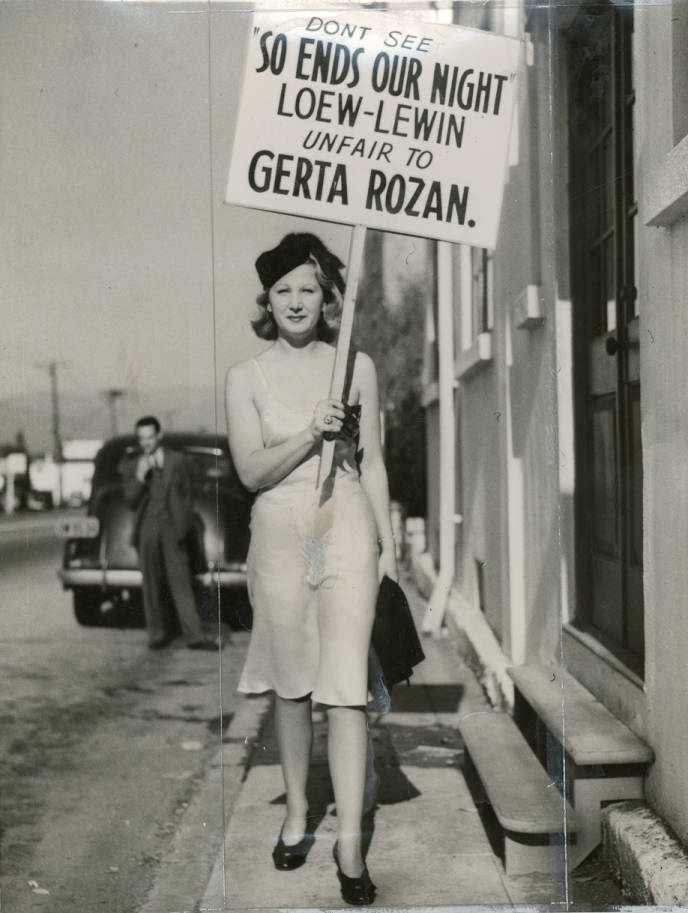
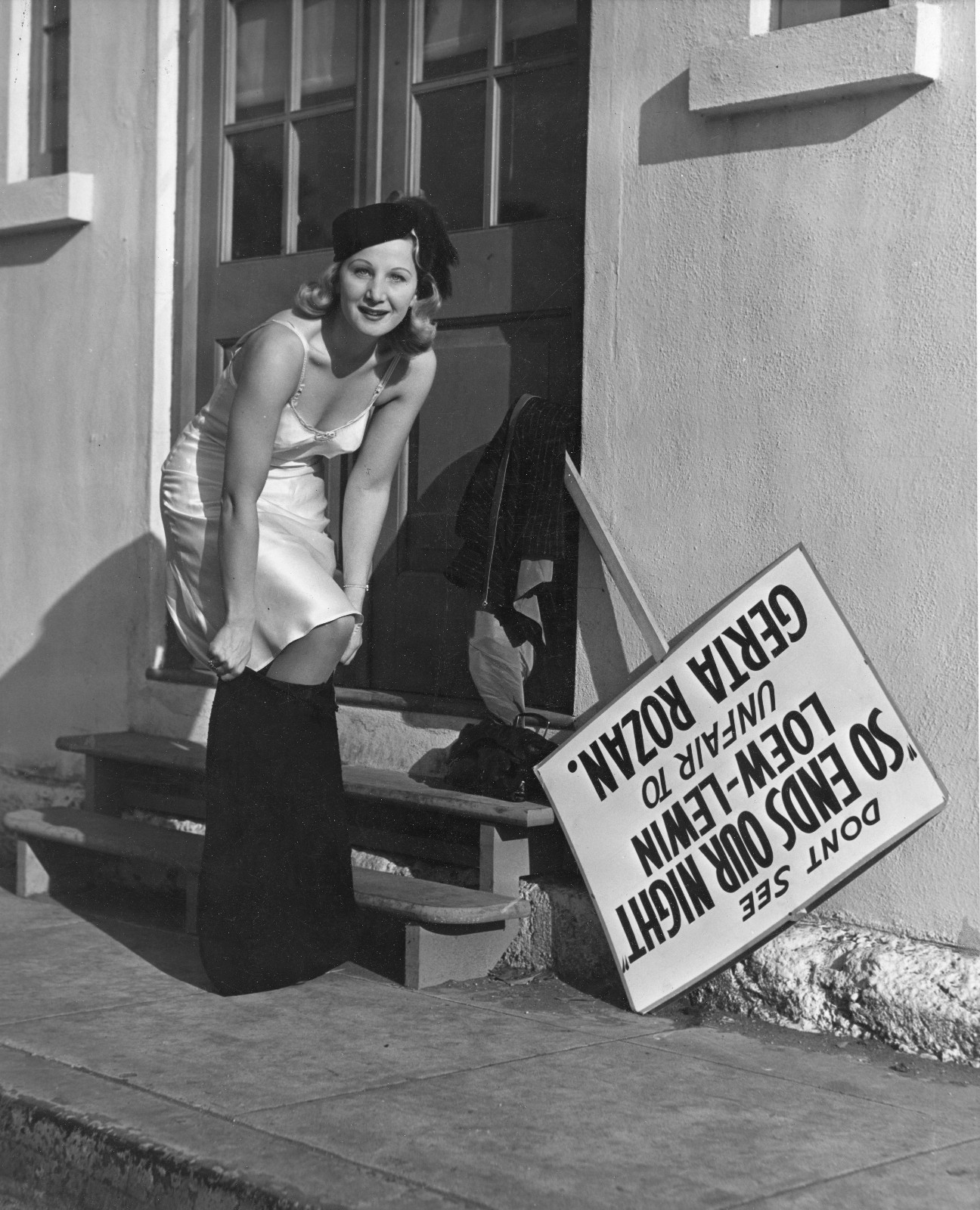
Matthew Coniam: The all-time classic in this regard must be the ‘strip picket’ affair, which unfolded before a rapt Hollywood in November of 1940. On the afternoon of November 25, a little-known actress called Gerta Rozan, who had been hired to appear in one scene of a Loew epic called So Ends Our Night and had supposedly discovered at a preview the weekend before that her scene had been cut, startled passers-by outside the office of Loew and his then-partner Albert Lewin by calmly removing her blouse. She returned the following day, before a loitering crowd and several lanes of stalled traffic, and removed her skirt. “Today, her slip is scheduled to go,” hyperventilated the Victoria Advocate on the 27th. A placard that she carried with her read: “DON’T SEE ‘SO ENDS OUR NIGHT’ – LOEW-LEWIN UNFAIR TO GERTA ROZAN.” “She intends to remove an extra layer of clothing every day until her part is restored,” explained Frederick Othman, with great beads of perspiration forming on his forehead and dripping on to his notepad, in the Milwaukee Journal. “And if this doesn’t take my face off the cutting room floor then I’ll just take off some more tomorrow,” added Rozan (in “her flimsiest chiffon brassiere and laciest panties”). Quite coincidentally, of course, “it was the sexiest love scene in the picture.” What were the odds! Loew carefully fanned the flames, somehow keeping a straight face as he complained she was “heaping ridicule upon the producers of a serious and profound motion picture.” On the third day, supposedly unable to take any more provocation (“We’re not getting our work done,” Loew complained to the credulous pencil-chewers), Loew and Lewin put a coat over her and took her inside, promising to either restore the scene or give her a part in their next picture, or both. For three days, Loew had achieved saturation coverage, got the name of his forthcoming film seen in every paper, and spread the word that it would now include for certain a hot love scene featuring a girl the nation had just seen parading up and down in her underwear. A pretty girl holding a banner saying ‘See So Ends Our Night’ might have secured a little coverage on a slow news day. Loew had the banner say ‘Don’t see So Ends Our Night’ - and owned the papers for three days running.
from The Annotated Marx Brothers
Hedda Hopper: George Glass was responsible for the topper in girl stunts. "So Ends Our Night"—which started Glenn Ford zooming—needed a shot in the arm. One of the bits was played by a pretty Viennese named Gerta Rozan, whose only sequence was being heavily cut. Each day she'd picket, carrying a placard—"YOU KEEP SNIPPING AND I'LL KEEP STRIPPING"—with the name of the picture in letters a foot high. Each day she'd remove another article of clothing. By the fourth day she was down to her slip, and plastered over every front page in town. By the fifth day, even George got scared. He dashed out, threw a coat over her black bra and panties, and dragged her inside. For conspicuous gallantry in action, they gave her a part in "Moon and Sixpence," but her strip-tease proved the climax of her career.
Modern Screen, July 1945
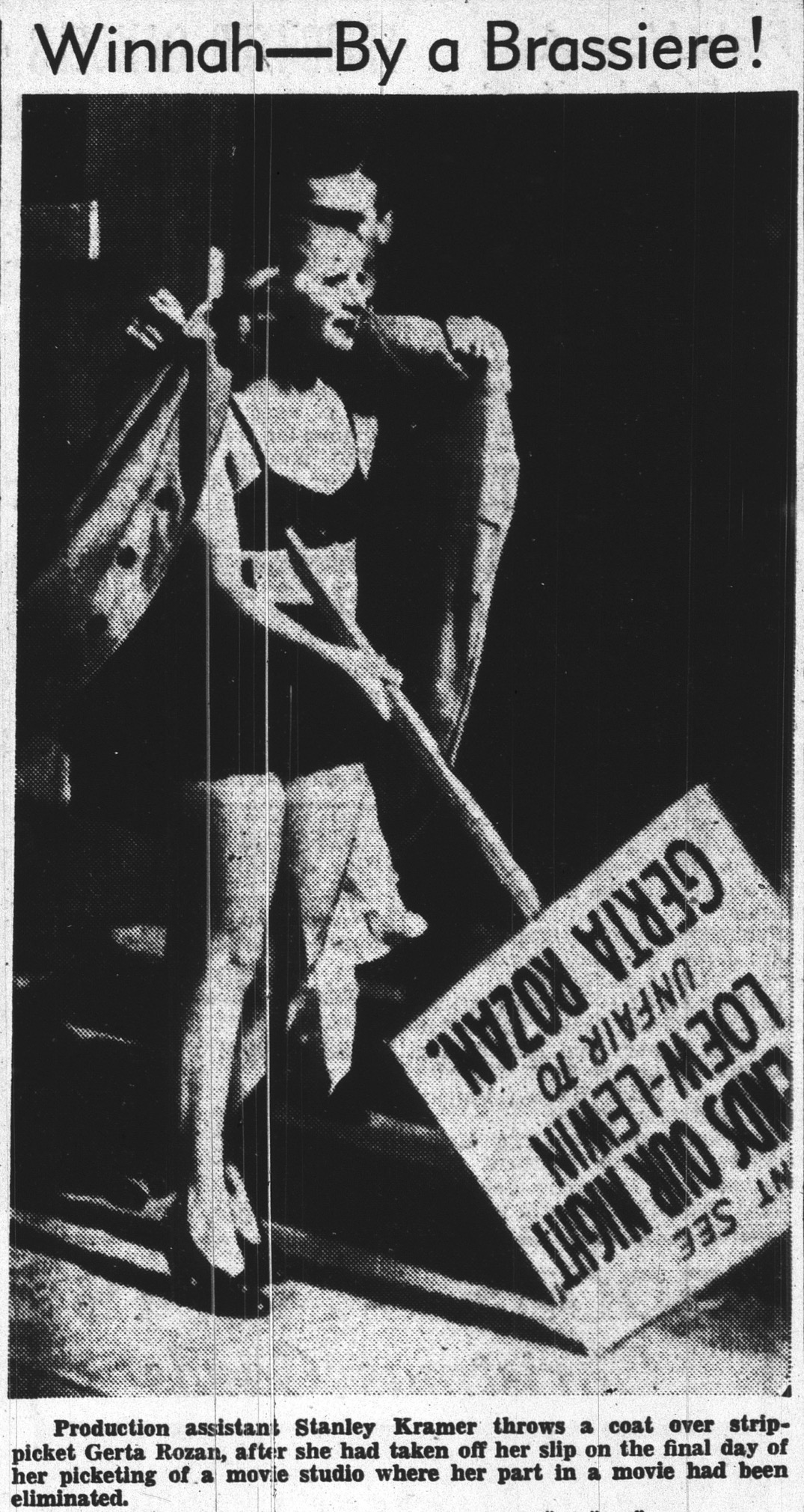
Strip-Picket Triumphs in Strike for "Girl's Rights"
Frederick C. Othman: Gerta Rozan, the strip-picket, kept on her clothes today, victorious by virtue of a black lace brassiere and lace panties to match, over two movie producers who thought they could take it—but couldn't.
The blond and curvaceous Miss Rozan picketed the Lowe-Lewin production offices in Universal City for three days in a one-girl, progressive stripping strike against their having cut the section in which she had acted out of a motion picture.
"My scene was the best in their picture," she reported last Monday when she stripped to her skirt and chemise in front of the offices of David Lowe and Albert Lewin, the producers.
"I was the girl who lived for love and I proved it to Fredric March," she added Tuesday, removing her skirt to march in her pink slip.
"I gave my everything to that picture, and they cut me out," she said yesterday shedding her slip to picket in brassiere and panties of black chiffon.
This occurred on one of California's sunniest days, on one of California's busiest streets. Motorists stopped for a good look—and kept on looking. The resultant traffic jam was enough to give Universal City police the jitters. They were used to semi-naked blondes, but they couldn't handle the goggle-eyed automobilists.
Miss Rozan ignored the hullabaloo. In one hand she carried a purse. In the other she held a banner which said "Don't See 'So Ends Our Night.' It is unfair to Gerta Rozan."
Continued on page 2.