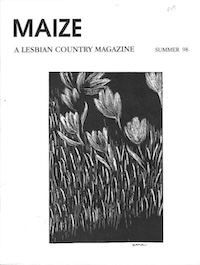
Julie is remembered by friends in the Summer 98 issue of Maize: A Lesbian Country Magazine,1 which also includes "The Night Our Julie Died" by Bethroot Gwynn,2 an account of how Julie's community — her chosen family — cared for her and each other in the wake of sudden tragedy. Read HERE at the Lesbian Poetry Archive (see pages 4-8).
Bethroot Gwynn also penned a companion poem entitled "She Took Chris, Then Julie" that makes reference to events described in her article mentioned above, and included it in her 2017 collection Preacher Woman for the Goddess.3 ("Chris" is Christine Pierce, another beloved member of the community, who took her own life earlier that same year.)
- To read click HERE and then go to pages 16-17 of that digital flipbook, corresponding to pages 62-63 of the original.
- Buy the book from We'Moon.

Manuscript copies of Bethroot Gwynn's article and poem reside in the Special Collections of the University of Oregon Libraries.4 Another folder in the same collection contains emails between members of Julie's community, sent shortly after her passing, and several luminaries in the world of lesbian literature and art are among the senders and recipients, including Tee A. Corinne, Jean and Ruth Mountaingrove, Tangren Alexander, H. Ni Aodagain, and LaVerne Gagehabib.5
Julie's construction skills are mentioned by Jemma Crae, a notable figure in the Southern Oregon lesbian land communities movement,6 in an oral history interview conducted by Heather Burmeister:
So I lived in this Dogwood place for sixteen years, and around in 1995 I decided that I wanted to build my own home. I wanted to build a home that was a really nice home, because I deserved it. I wanted a nice place, and I wanted a place for the community. I wanted a place to do my concerts, so I designed this home called Woodsong. I designed it to have a kitchen and a big living room to have groups of people in and groups of women in and the concerts. I had two friends who were really handy--Osima and Julie--and they had worked on Bethroot's She Wings, so I asked them if they would like to form a construction company and build my home. They said, "Yes, we will." So they got a CCB number and formed a little construction company, because they had to, in order for us to do all of the permits and everything. We built Woodsong. Woodsong took nine months to build, which is amazing.7
Hannah Blue Heron mentions "my friend Julie Hopp" in passing in her collection Self Portraits in the Nude.8
Julie sent the following letter to a fellow Peace Corps volunteer in the fall of 1984, as the end of her two-year term of service as a secondary school teacher at Ndigwa, Kenya, was approaching:9
9 September, 1984
Dear Jerry,
The grass opposite the garden, which I see through the window, is eight feet tall. School opened last week, but only a few students have come. Those who did were sent back home for fees. At first I thought they should let the local animals come graze on the compound to crop the grass, but then some did come in and instead of the grass, they ate the leaves of my small maize. It's only rained once in the past two weeks, so I don't suppose it'll come to fruition, anyway. The beans have pods, though, but small ones.
Even the headmaster didn't show up the first day of school. Perhaps he'll come on Monday so we can have a staff meeting. My friend Oyugi, one of the pre-university national youth service guinea pigs, returned. On the day before the President was to come to their passout ceremony they rioted: stormed the gates of the army's 5th battalion barracks in Gilgil, emptied the canteen; then went into town, ransacked the biggest bar, the Salama, ate 10's of kilos of meat and refused to pay, overturned the car of the deputy director of the NYS, marched him to the police station and forced the release of their comrades who had just been locked up for such anti-social behavior as just mentioned above. So much for "instilling discipline." My friend Rose just came to lay claim to various household goods which I'll leave behind. I've been eating at their house all week, having run short of fossil fuels and culinary motivation.
I got 6 boxes of books from various friends and relatives. We filled up all the shelves of the library. I suppose I could have gotten hundreds more if I'd tried all the names on those Peace Corps lists. I did write 60 letters, and agreed with the headmaster that the school would pay postage (they were all to America), but he always delayed, and they've been gathering dust in a corner for 6 months now. At this point, I don't really care (although I'm not sure there ever was a point at which I cared).
Well life's just as smooth as Blue Band, but not quite as bland. Hope yours is not too dull. Here's a photo, see you soon.
Love,
Julie
Recollections of Julie
1. "Remembering Julie." Maize: A Lesbian Country Magazine, no. 58, Summer 1998, pp. 4-5. ↩
2. Gwynn, Bethroot, with assistance from Katherine Jensen and Diana Bailey. "The Night Our Julie Died." Maize: A Lesbian Country Magazine, no. 58, Summer 1998, pp. 6-8. ↩
3. Gwynn, Bethroot. Preacher Woman for the Goddess: Poems, Invocations, Plays and Other Holy Writ. Mother Tongue Ink, 2017, pp. 62-63. ISBN: 978-1-942775-12-6 ↩
4. Writings re: Julie Hopp. SO-CLAP! Collection, Coll 266, Box 11, folder 31, Special Collections & University Archives, University of Oregon, Eugene, Oregon. Read here ↩
5. Correspondence and email re: Julie Hopp. SO-CLAP! Collection, Coll 266, Box 11, folder 35, Special Collections & University Archives, University of Oregon, Eugene, Oregon. Read here ↩
6. Burmeister, Heather Jo. "Rural Revolution: Documenting the Lesbian Land Communities of Southern Oregon". 2013. Portland State University, Dissertations and Theses, Paper 1080. doi: 10.15760/etd.1080 link ↩
7. Jemma Crae oral history interview, 2011 January 13, Coll429_do006. Southern Oregon Lesbian Land Communities Oral History Collection, Coll 429. University of Oregon Libraries, Special Collections and University Archives. Transcript: p.18. Video: 00:39:56 link ↩
8. Blue Herron, Hannah. Self Portraits in the Nude. Trafford Publishing, 2006, pp. 3, 197. ISBN: 1-4120-9899-8 ↩
9. Transcript kindly provided by the recipient. ↩